

The Visual Gap in Independent Documentary and Journalism Work
Independent documentary filmmakers and journalism creators face a distinct visual production challenge unlike commercial producers. Their work often covers subjects that cannot be easily filmed: historical events, abstract concepts, geographically inaccessible locations, or sensitive scenarios with restricted or ethically complex camera access. Traditional production relies on archival footage, illustrative photography, and animation to fill these gaps, but each carries access barriers and steep costs. AI video generation is unlocking new possibilities for independent visual storytelling, with meaningful implications for the field.
Visualizing What Cannot Be Filmed
The most immediate practical application of AI video generation for documentary creators is the visualization of subjects that resist direct filming. Historical reconstructions, speculative scenario illustrations, conceptual explanations of abstract processes, and environmental contexts that no longer exist or cannot be safely accessed — these are the visual gaps that documentary production has historically filled with archival material, animation, or simply accepted as limitations.
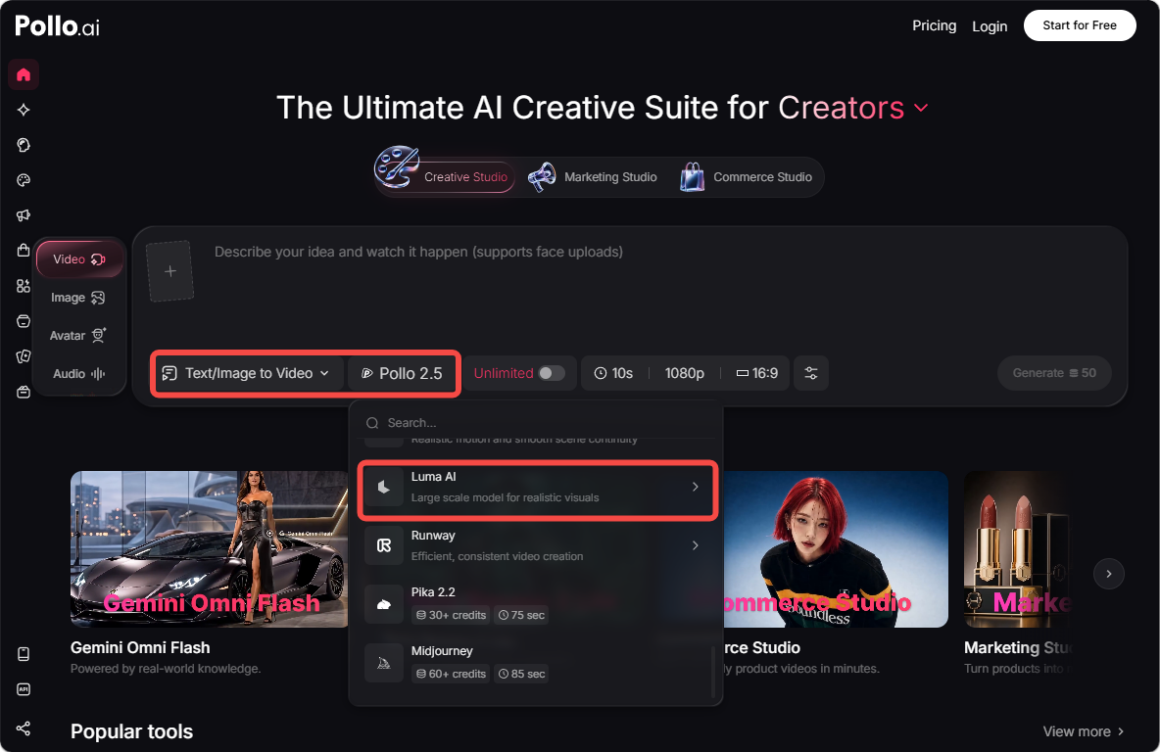
Luma AI, available within the Pollo AI platform, brings photorealistic quality that makes AI generation a genuinely practical documentary tool, a major step up from earlier generation tools. Its 3D modeling foundation produces motion and environmental rendering grounded in real physical logic: accurate lighting physics, authentic surface textures, and precisely rendered atmospheric conditions. For creators visualizing historical urban landscapes, vulnerable ecosystems, or microscopic scientific processes, this physical realism makes generated footage credible illustrative content rather than obvious synthetic filler. Text-to-video turns detailed scene descriptions into cinematic footage, while image-to-video animates archival photographs into dynamic sequences, elevating historical visual material to modern production standards.
How AI Generation Is Affecting Independent Journalism Visual Standards
Visual benchmarks for independent digital journalism continue to shift alongside newsletters, video podcasts, and creator-led news channels. Text journalism has clear standards for accuracy and sourcing rigor, but visual norms for journalistic video remain fluid, with audience expectations varying by platform and publication context.
AI tools are entering this space as viewer demands for independent journalism video quality rise. Audiences of YouTube news channels, video podcasts, and documentary-style series have grown accustomed to polished production values, putting under-resourced independent journalists at a growing disadvantage for audience attention.
For independent journalism creators, AI delivers the most value not in core reporting — which must remain rooted in authentic documentation — but in supporting visual assets: illustrative sequences paired with narration, atmospheric establishing shots for geographic or temporal context, and conceptual visualizations that help audiences grasp complex systems and processes.
Music and Audio Identity in Documentary and Journalism Content
Documentary and journalism content leverages music differently from commercial or entertainment video. Rather than serving promotional or entertainment functions, music in these contexts builds atmospheric tone, guides narrative pacing, and signals section transitions. Musical choices convey a creator’s unique perspective and aesthetic sensibility, and the visual treatment of music in trailers or social previews directly shapes audiences’ first impressions of the full work.

For creators producing promotional trailers, episode previews, and social clips, the Create Lyric Music Video tool within Pollo AI delivers value beyond standard music promotion use cases. It accepts audio files and generates rhythm-aligned, mood-matched visuals synchronized to the track’s emotional character, creating more immersive promotional content than static title cards or basic imagery.
Its beat-synced caption animation and AI virtual performer options let creators build polished series trailers and host-focused content that clearly convey a work’s tone and core subject without extra on-camera recording sessions. For documentary projects with distinct audio identities — signature themes, unique sonic atmospheres — the tool extends that identity into shareable social content, supporting organic audience discovery on platforms where documentary viewership continues to grow.
Ethical Considerations That AI-Assisted Documentary Creators Must Navigate
The use of AI-generated footage in documentary and journalism contexts raises ethical questions that commercial video production does not face in the same way. Documentary and journalism content carries an implicit claim to factual representation that commercial video does not, and the use of AI-generated imagery to illustrate real events or real subjects requires careful disclosure and framing to maintain the trust that journalism depends on.
The appropriate use of AI generation in documentary and journalism work is as explicitly illustrative material — clearly framed as visualization or reconstruction rather than documentation — rather than as footage that is presented as authentic recording of real events. Creators who establish clear disclosure conventions for AI-generated content in their work are building the trust framework that allows the technology to serve legitimate storytelling purposes without undermining the credibility of the journalism itself.
Luma AI within Pollo AI is a tool for visualization, not documentation. Its photorealistic output quality makes this distinction more important to communicate clearly, not less — precisely because the quality is high enough that audiences might not immediately recognize generated footage as generated without explicit disclosure.
Practical Applications: Building a Visual Production Workflow for Documentary Creators
Map Your Script to Visual Gaps
Review your documentary script or journalism piece and identify every moment where the narration describes something that cannot be directly filmed — historical events, future scenarios, abstract processes, inaccessible locations. These visual gaps are the primary candidates for AI generation, and mapping them before beginning any production session ensures that the generation workflow is directed at the content’s actual visual needs rather than used speculatively.
Generate Illustrative Sequences With Explicit Scene Descriptions
For each identified visual gap, write a generation prompt that describes the scene with the specificity of a production brief: the environment, the time period, the atmospheric conditions, the scale, and the emotional register appropriate for the narrative moment. Use Luma AI within Pollo AI to generate multiple visual interpretations of each scene, and select the output that most accurately serves the narrative context rather than the output that is most visually striking in isolation.
Develop Promotional Content That Reflects the Work’s Atmosphere
Use the Create Lyric Music Video tool within Pollo AI to produce promotional content for documentary releases and journalism series that communicates the atmospheric register of the work to potential audiences. Upload the series’ musical theme or a representative audio excerpt, and use the generated visual content as the basis for platform trailers, social clips, and episode preview content that gives audiences a genuine sense of the work’s tone before they commit to watching.
Conclusion: A Tool for Visualization, Not a Replacement for Documentation
AI video generation tools are expanding what independent documentary and journalism creators can visualize, not replacing the authentic documentation that gives their work its credibility and value. Luma AI within Pollo AI provides the photorealistic quality standard that makes AI-generated illustrative footage useful in professional documentary contexts, while the Create Lyric Music Video tool extends the platform’s capabilities into the promotional content formats that help documentary and journalism work find its audiences.
The creators who will use these tools most effectively are those who apply them with clear editorial intention — using generation to fill genuine visual gaps in service of authentic storytelling, rather than as a substitute for the documentary instinct that makes the work worth watching.